You’d think that the hard part would be getting the seeds to germinate and coaxing that little seedling to grow. But time and again I see gardeners stumble just at the finish line: harvesting.
All season long plants have been tended and, just at the big, edible moment of payoff, the gardener hesitates: “Is it ready? Should I wait? Will it get bigger? Am I too late?”
Nothing seems to stump new gardeners more than the harvesting of broccoli and cauliflower. This makes sense, really. Most of the fruiting “vegetables” like tomatoes and peppers turn color when they are ready to be harvested so there’s a strong visual clue. Most of the leafy vegetables can be harvested at many sizes and still give you a great result: baby lettuce = yum! Head lettuce = yum!
But with broccoli and cauliflower you are really playing a game of chicken with the plant. You are trying to let the head grow as big as possible without going over and into the flowering stage, when it turns tough and bitter.
Funny, It Doesn’t Look Like A Flower
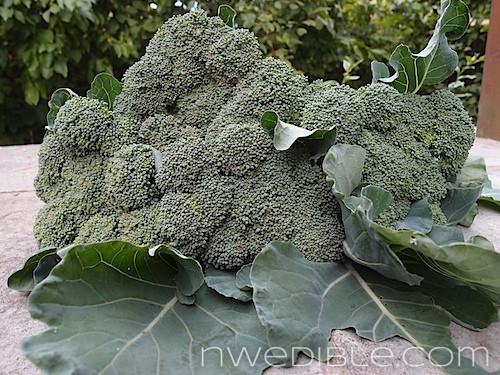
That’s just how I like my broccoli.
To figure out when to harvest, it helps to know a little about what you are actually eating when you eat broccoli or cauliflower. It’s a bit easier to explain with broccoli – and I have a bunch in my garden right now so I can show what I’m describing – so I’ll use that example, but everything I’m about to say holds true for both vegetables.
Broccoli is a member of the brassica family that has been bred to make a giant succulent flower head. It is that flower head that we eat. The teeny little green beads that make up a head of broccoli are called florets. Each one of those florets wants to develop into a pretty yellow flower and make seed. If broccoli is given enough time, it will grow a big afro of yellow flowers.
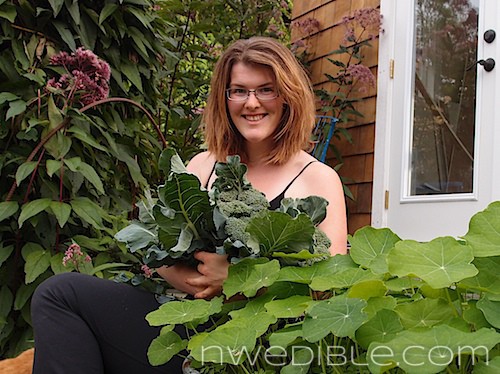
My kinda bouquet.
You want to have eaten all those florets long before that happens because when a broccoli plant (or any plant, actually) goes into it’s flowering and seed making stage, certain changes happen to the plant that cause it to toughen up and get serious about survival. Leaves get bitter, stalks get tough and woody and the broccoli spends a lot of money on onsies and diapers as it prepares itself for plant parenthood.
Not Too Old, Not Too Small, But Just Right
So, how do you harvest a head of broccoli when it is full-size but before it goes too far?
First, look at size. Different varieties have different natural mature sizes, and like everything in gardening there is a lot of potential variability based on growing conditions. In my garden, I’m happy with a main head of broccoli that is 6 to 7 inches across. That’s a very respectable head of broccoli.
All else being equal, broccoli and cauliflower will make heads in accordance to their leaf growth before they start heading. In other words, big broccoli plants with big healthy leaves will make big broccoli heads and stunted little broccoli plants will make stunted little broccoli heads. Broccoli plants that are bred for bigger frames will tend to make larger heads than “compact spacing” type varieties.
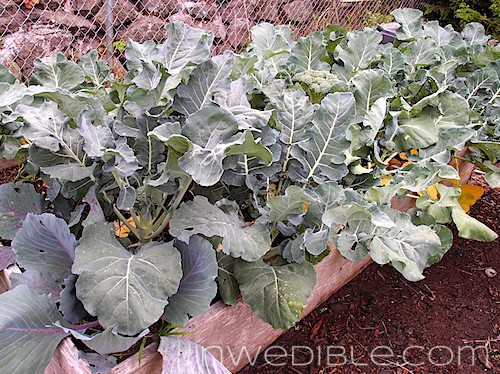
These are nice big, healthy broccoli plants so I expect larger heads from them.
This is why you must never, ever, EVER buy a broccoli or cauliflower transplant that has already started to form a head. You might think, “ahh, that’s so cute! An inch-wide cauliflower plant. I’ll get that one, it’s got a great headstart, so to speak.”
DO NOT DO THAT!
That broccoli or cauliflower is, for all intents and purposes, done. It has already initiated it’s heading up as, essentially, an infant. It will not get bigger. If you buy that transplant you are paying probably $80 a pound for button-sized broccoli. You are wasting your money.
Full size, healthy broccoli and cauliflower plants will start by making a small head but that head will get bigger. Many a new gardener, myself included, has panicked when they see their first teeny little cauliflower or broccoli head and thought, “Oh no! What did I do? I ruined it! It’s teeny.”
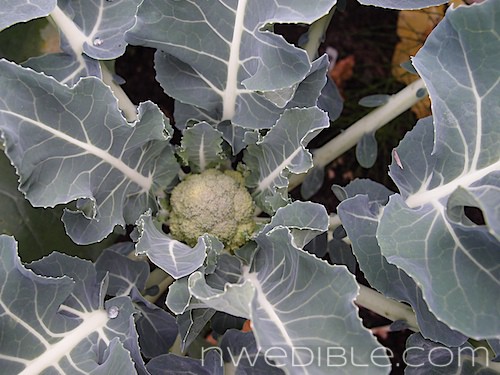
Only just beginning…give this one time
Web searches will say things like, “broccoli and cauliflower will button (produce small unusable heads) when under stress,” adding to the feeling of panic and garden failure. So, the typical new gardener reaction is to cut off the teeny baby broccoli head in an attempt to “salvage something…anything!” from their plant.
Tragedy. That’s basically broccoli head infanticide. The right response is…patience. Those little broccoli heads start little but they will get bigger…up to supermarket size or larger, if they are happy and growing well. So just watch and wait.
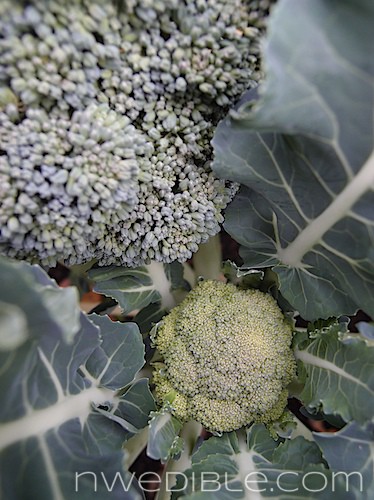
Part of a full-size head (upper left) compared to a baby broccoli head (lower right)
Look At The Florets
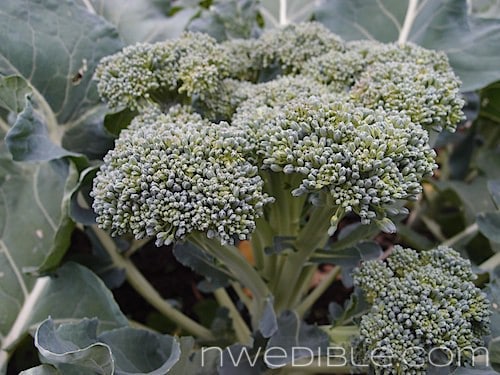
There will be a point, a several day (or even several week, depending on the variety) window, when the broccoli or cauliflower crown hits full size and stops growing but starts to loosen up. The individual florets will get fatter and then will spread apart slightly and take on a less tightly packed quality.
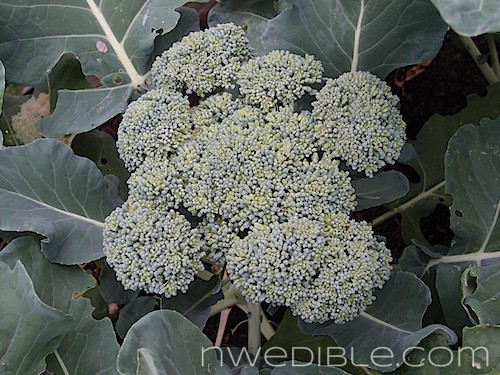
Loose but not yet yellowing – pick now!
This is the ideal time to harvest. This is slightly later than what you will see for store bought broccoli, but since your broccoli isn’t going to be on a truck for a week you can maximize size a bit more than the commercial growers can without sacrificing quality.
At this point the head is as big as it’s going to be and still tastes great and is juicy and tender. Let it go a bit longer, maybe 2-3 more days – possibly a week if you have a broccoli with good field holding ability – and the florets will start to get a distinct, loose, spread out look. Those green beads will start to look like fat little flower buds, because this is exactly what they are. They will seem to elongate, moving to a more oblong shape.
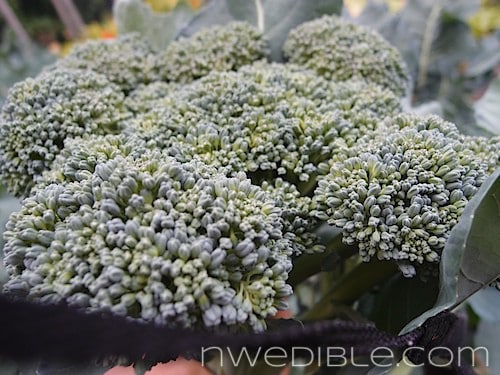
Watch for spreading out florets and signs of yellowing.
At this point the broccoli is still good eating quality but is moving rapidly towards flowering and the further along it gets the tougher and more mealy it will be. The florets will get progressively looser, and may start to take on a yellow-tinged look in places. I never like my broccoli to get to this point, it’s just too far.
One day a few of the flower buds will open into a cruciferous yellow flower. Last call, dude. If you have not yet done so, for God’s sake, harvest your broccoli now. It won’t be the most delectable crudite on the tray but it will still probably be alright compared to a two-week-old grocery store specimen.
Once your broccoli head starts actively flowering, you can still eat it – it’s not poisonous or anything – it just won’t taste the same as it would have a few weeks prior. If you do opt to harvest broccoli in flower, consider cooking it like you might flowering kale or mustard greens because it will be stronger than younger broccoli would be.
After The Harvest
If you were a commercial market grower, after you cut the head off all your broccoli plants (at more or less the same time because labor is expensive) you would rip up everything and replant. As a backyard grower, you shouldn’t do that.
Cut the broccoli head off, and cut it fairly low. Give yourself 6 or 8 inches of stalk to go with the head. (Hey, I’m still talking broccoli, don’t be a pervert.) Then, let the broccoli continue to grow and it will form side-shoots. Certain varieties, like Umpqua and Waltham 29, are more prone to continued side shoot production and those varieties are good for home gardeners.
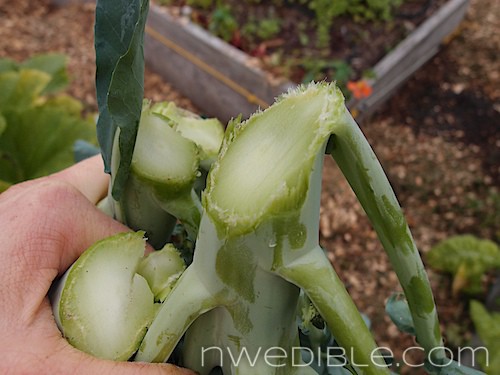
If harvested when still tender, the stalk can be peeled and used in slaws or sauteed. It’s fantastic.
These side-shoots are the plants attempt to make seed. Many varieties will work really hard to fulfill their quest to become parents by sending out dozens of side-shoots. They aren’t nearly as big as the central broccoli head – more broccolini sized – but you can get a good handful of them off a few plants if conditions are good. Harvest side-shoots the same way you harvest the central head but note that they will run to flowering faster.
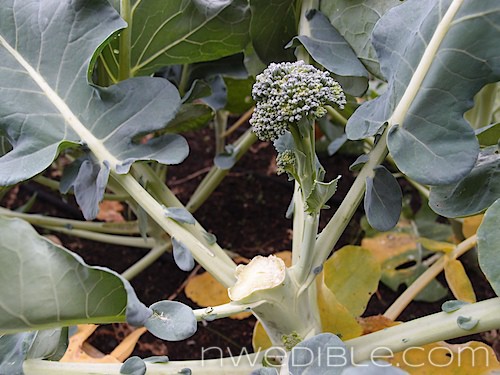
A side-shoot growing after the main head has been harvested.
Eventually, even the most tenacious broccoli plant will give up and stop putting out usable-sized side shoots. This is when you harvest the leaves. Broccoli leaves are practically indistinguishable from collards or the scotch-type kales in most cooked-greens recipes. You can substitute to your heart’s content.
If you have a lush garden and you aren’t interested in eating broccoli leaves because you are too busy stuffing yourself with cherry tomatoes and figs, I recommend ripping up the plant and making a chicken pinata with it. Shake off excess dirt, tie a string around the plant where the stem meets the root system and hang the broccoli plant upside-down in your chicken run somewhere. Chickens love broccoli and will have a blast pecking at the leaves.
Are there any vegetables that you are unsure about when to harvest? I always have to double check specific herbs. Is it when they are in flower? Just before flower? But that’s what I love about gardening – there’s always something to learn.
244
Many many many thanks for all the advice. This has been the first time ever I have planted broccoli.
I look forward to becoming a good vegetable gardener soon.
Thank you for the great explanation. When you say cut the head off, do you mean just the flower head? Or do you cut the leaves and flower head off at the same time?
thank you so much! this is exactly what I was needing to know! I haven’t grown broccoli since high school and needed a refreshed on when to harvest. your information was the best I found! thank you!!!
Great article. “Is it ready? Should I wait? Will it get bigger? Am I too late?” That line about summed up what I was thinking. I noticed the little yellow flowers and wondered if I should harvest and sure enough I did but they must have blossomed early that morning because they weren’t there the previous day. They still tasted great. Thanks for the help.
I use Seven dust and it is GREAT! Also lime is good too! Thanks for this awesome article.. I love the comedic factor in there…. 😉
Hi I was wondering if cauliflower makes the shoots after the main head is harvested like broccoli? Or if once you cut the main head you should just compost the plant because it’s done reproducing?
thanks
This is fantastic and super informative! I just harvested my carrots and my broccoli looks super healthy, but the heads are definitely still too small- and growing! I am excited to harvest and now know when to. Hoping my broccoli produces the small shoots after the first harvest too 🙂
THANK you again!!
Great post! Thanks so much for the clear and detailed description! I have 6 broccoli plants growing right now, ranging from 3″ to 6″ in head diameter. Can’t wait to harvest.
I was literally discussing this w a friend in my garden last night. I told her I didn’t think the heads were going to get much bigger but I wasn’t sure if I should pick them. Looked at the seed pack today and it’s actually a variety that only gets 3-4 in across and does lots of shoots. Reason #89 on why you should never throw the seed pack away!
Can I keep the plant in the ground once it is finished producing broccoli and after I harvest the leaves? Or this plant needs to be replanted every year?
Thanks
my first attempt at planting a garden and your advice has been a really big help
Thanks for this post.
I get tons of brocollini every day from 4 Plants. It just keeps on coming.
I don’t even care about how big a broccoli head gets because I want to eat mine right away at the very peak of it’s nutritional value and the subsequent broccolinis are so sweet and tender. Sometimes broccolinis in the market are as high as 7 bucks a lb.
If I pick a huge one I will not be able to eat it at it’s peak because there is more than my husband and I can eat in a sitting. I just love broccoli!
Then there is the subject of the leaves. I have learned never to pick a leaf that is shading a brocollini because it needs that shade to stay as green as it can as it comes to fruition. However, I do love the leaves as much as the flowers. They too taste great!
I eat it every day and fortunately I live in Northern Cal where we can grow year round.
It is June 5 2016. I have two respectable plants in my greenhouse. Is that head ready yet? I remembered seeing the ultimate guide on this blog. Google.
Ah yes. Give one a few more days, grab the other one now. There will be multiple good sized side shoots. Packman is great for that. Your blogging days may be waning, your work is still being used. Mwwahh.
We are growing a broccoli plant in a greenhouse. The plant is beautiful and is getting extremely talk and not starting to produce any heads. Is there any way we ca encourage the plant to start producing the head and not the body of the plant. Thank you
I do not know if it’s just me or if perhaps everyone
else encountering issues with your website. It appears like some of the text in your content are running off the screen. Can somebody else please comment
and let me know if this is happening to them too? This might be a
problem with my web browser because I’ve had
this happen previously. Thank you
I have a cauliflower plant and I just harvested the head the head has yellow and purple all over on it is it still good to eat , can cauliflower make you sick? is it ever no good te eat?
Hi……………….I had lovely broccoli and cauliflower this summer after the frost which in Bend Oregon could be any day: my question now that the plants are done do I just dig them up and get rid of them? They are not perennial correct?
Thank You! Finally I got answered all the questions about harvesting broccoli and what to do with it afterwards.