Grassfed vs. Organic Butter, And Which One Will Kill You Faster

butter

Butter Basics

Butter. Oh yum, butter. Butter on corn, butter on scones, green beans in brown butter, buttercream icing, herb butter… Oh, butter, no other fat is quite like you, and we love you for it.

But let’s start at the beginning. Cow’s milk is separated into milk and cream. Butter is made from agitating (churning) this cream until the fat globules stick together and separate from a thin liquid called buttermilk. In the US, commercial butter must be at least 80% fat. The rest is generally water, milk solids and salt.

Basic butter quality is determined by freshness, fat content (higher fat means a richer product) and salt levels. Salting both flavors and preserves butter, helping it to last up to several months longer than unsalted butter. The longer shelf life of salted butter is both a blessing and a curse. Added salt means your butter in the fridge or on the counter stays fresh longer, but also means the store can sell you older butter, and the butter manufacturer can use older cream to make the butter.

In general, quality flaws and age can’t be “hidden” in unsalted butter. Plus, when you use butter as an ingredient, the salt level in the butter can change the flavor of your finished good. This is something bakers, in particular, think about. For these reasons, the standard advice is to go with unsalted. You won’t get an argument from me, but I but, to be frank, I like salt and I usually buy salted butter.

Grassfed Butter vs. Organic Butter

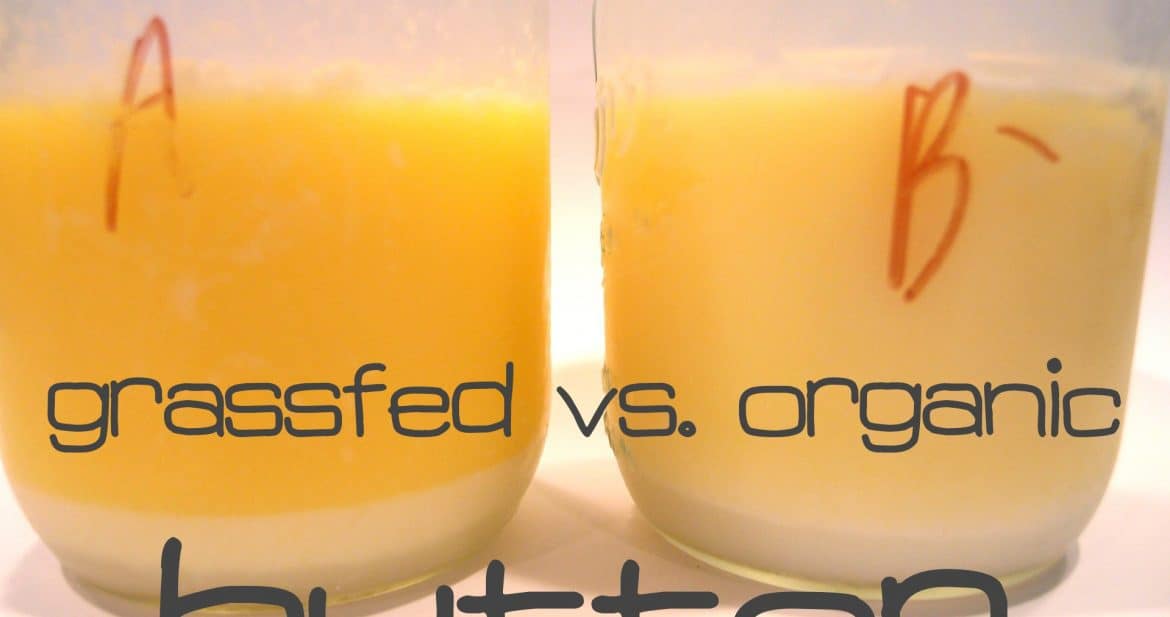
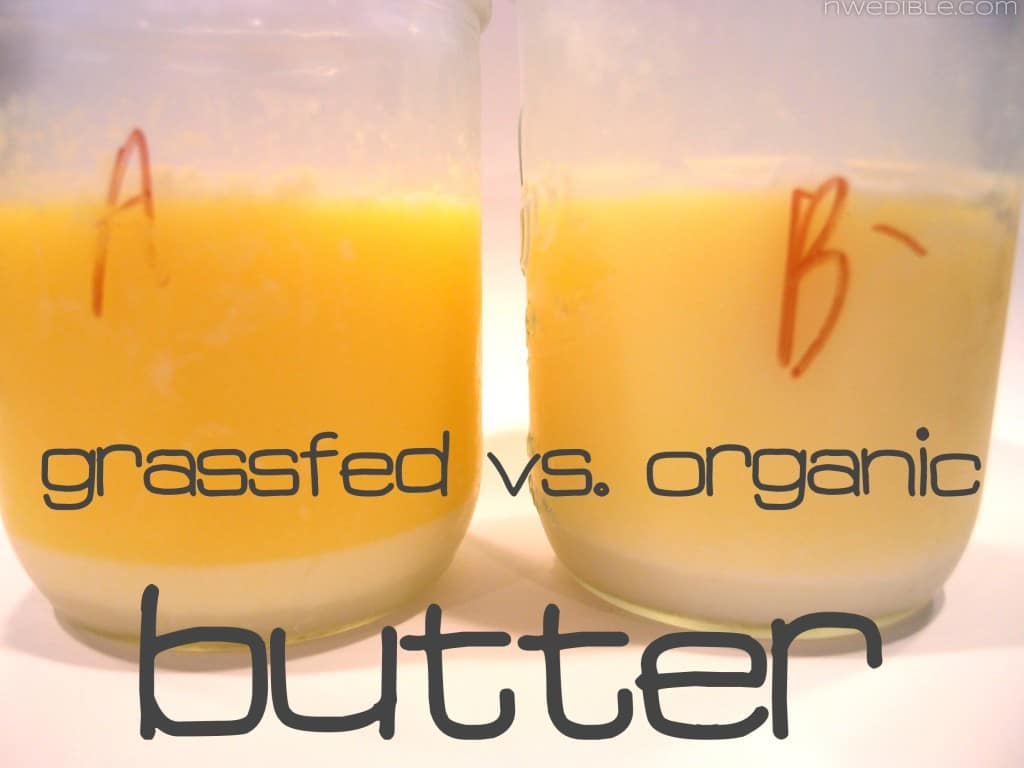
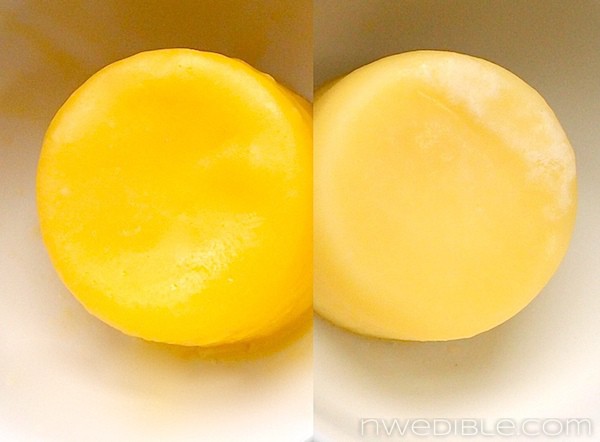
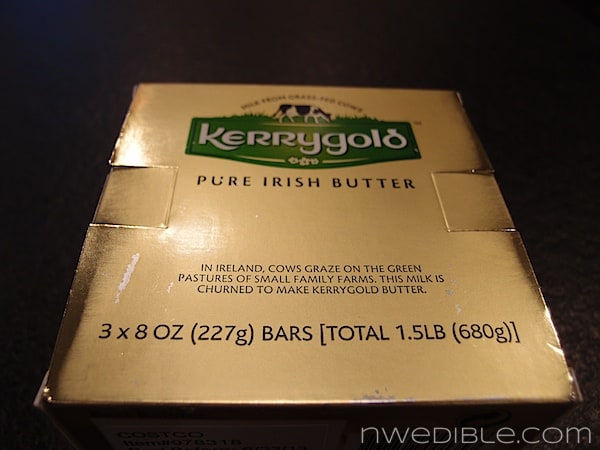
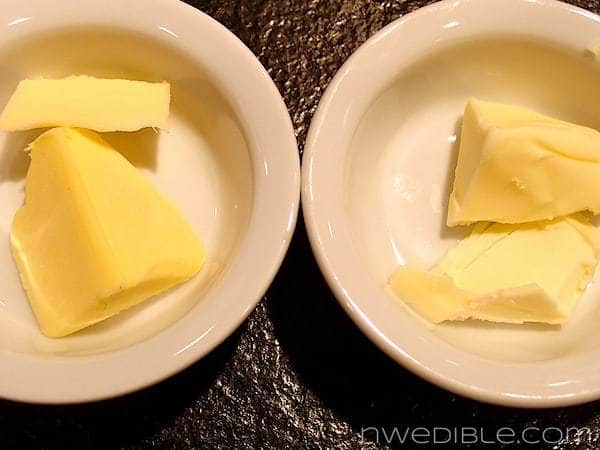
I compared two butters. In all photos, (A) on the left is Kerrygold, a rather well distributed grass fed butter from Ireland. (B) on the right is the Costco Kirkland Signature Brand Organic Butter I normally buy.

The Kerrygold at Costco was $6.99 for 3, 8-ounce bars, or $4.66 per pound. The KS organic was $7.99 for 2 pounds, or $3.99 per pound.
Butter (11)

I know some people have a problem with Kerrygold (hello, environmental impact of butter from Ireland!) and I’m sure it is not as delicious as the cultured butter some of you make from raw milk you get from a farm 14 minutes away, but it’s commercially available for a moderate price more or less nationally, so it’s good for this taste test.
The Taste Off

So, which delicious slab of saturated fat was more delicious? The grass fed butter was noticeably darker and more deeply yellow than the conventional butter. The photo below doesn’t actually capture how different the color was in person. Striking difference.
I asked my husband and daughter to weigh in with opinions on which butter they preferred.

My daughter on the appearance: “(A – grassfed butter) is more yellowy, a soft yellow. (B – organic butter) is more white and plain. It looks harder.” (Note both butters were at the same cool room temperature.)

Neither was told which butter they were tasting when they gave eyes-closed feedback.

Comments about (A) – The Grassfed Butter

  • “Hell of a lot more going on.”
  • “Full and creamy, nicely salty.”
  • “It tastes like it lasts a lot longer in your mouth, like after you swallow it you can still taste that there is butter there.”
  • “Melts like butter. Soft.”
  • “Really good.”

Comments about (B) – The Organic Butter

  • “Smooth, slightly sweet.”
  • “Tastes…like butter.”
  • “Really salty but the flavor doesn’t last very long.”
  • “It’s more lubricating than flavorful.”
  • “Feels hard but melted quickly.”

My daughter concluded, “I would rather have less salty (A) for longer than super salty (B) for a short period of time.” Both definitively preferred the flavor of the grassfed butter, praising a more complex and longer lasting flavor. In contrast the organic butter seemed overly salty and simple in flavor profile.

Clear Winner: Grass-fed

Why Organic? Why Grass Fed?

Why buy fancy-pants butter in the first place? Most people who seek out organic dairy do so because they believe it to be healthier, both for the planet and for the end-consumer. I’d guess that everyone who seeks out grassfed dairy thinks they are buying a healthier product.

But the specific “better” reasons for these two specialty butters tend to have a slightly different focus. Organic dairy is thought to be less contaminated by pollutants and toxins, whereas grassfed dairy is primarily praised for a better micro-nutrient profile, including much higher levels of CLA, better Omega-3 to Omega-6 fatty acid ratios and dramatically higher levels of Vitamin A and E.

Now, I happen to agree with the grassfed proponents on the nutrition stuff, and go out of my way to buy grassfed beef and, slightly less consistently, grassfed milk.

Let’s talk contamination. Pesticides, herbicides and toxins tend to build up over time in the fat, including in the dairy fat of animals. (More on this later.) It is a reasonable assumption that animals fed foods less tainted by these pesticides, herbicides and toxins would make foods, including milk and dairy products, less tainted by them.

Most large scale dairy operations practice some degree of confinement feeding, where corn and soy based feed are brought to the cows, instead of sending the cows out to eat grasses. This is true even for large organic dairies, with the major difference being that the corn and soy feed is (supposed to be) certified organic.

My sister, a professional animal scientist specializing in dairy breeding, once described to me the facilities at a major (major) organic dairy she toured. The cows walked around on bare dirt and were fed grain from troughs. The only thing that distinguished this operation from any other industrial dairy was the organic certification of the pesticides sprayed on the feed grains that were eventually given to the cows. My sister was not impressed.

Be that as it may, the theory is that, because of reduced exposure to pesticides, herbicides and other toxins on the feed, organic dairy is less contaminated than conventional dairy.

Grassfed dairy cows, like grassfed beef cows, graze only on pasture and dried forage and are therefore in theory are not getting any added toxic chemicals in their diet. But in practice, as you probably guessed, it’s more complicated.

Will Your Butter Kill You? The Giant Toxic Dairy Fat Issue

Unless you are opposed to butter on ethical (animal product) or fat-avoidance (fat! fat! fat!) grounds, there doesn’t seem to be a whole lot not to love about this substance. It’s delicious. It has great mouthfeel. It carries other flavors beautifully.

But there is one little thing that takes the shine off butter, and it’s called bioaccumulation. It turns out that animals tend to store many of the various chemical environmental toxins they are exposed to, like dioxins and nasty pesticides, in their fat. Fat is like the body’s savings account for building up a nice stash of terrible toxins.

In lactating mammals (including dairy cows and nursing moms) these chemicals are stored in the milk fat, too, and are in turn absorbed by whomever consumes that milkfat, be they calf, infant, or Starbucks Venti Whole Milk Latte lover. (Infants, our littlest, most vulnerable people, have some of the highest levels of toxic burden shoved upon them because of this milk fat toxin issue.)

Since butter is mostly fat, it is one of the most concentrated food sources of these bioaccumulative toxins. According to the Environmental Protection Agency’s Evaluation to Measure Persistant Bioaccumulative Toxic Pollutants in Cow Milk (link goes to a PDF):

The US EPA estimates that approximately 35% of an adult’s daily intake of dioxins is derived from dairy products. The percentage for children is even higher. Persistent, bioaccumulative and toxic pollutants (PBTs), including dioxins, bioaccumulate through the food chain and ultimately result in low-level contamination in most animal fats. It is important to understand the PBT levels in milk, as milk fat may be one of the highest dietary sources of PBT exposure. Analysis of milk also allows the opportunity to investigate geographic variability, as milk is produced and distributed on a regional scale.

So, to summarize, dairy cows store many icky chemical pollutants in their fat, including their milk fat. Dairy items highest in fat, including cheese, ice cream, cream and, alas, butter, are the most likely to contain concentrations of those icky chemical pollutants, and whenever we eat these goodies, the toxins go right into us.

And these bioaccumulated toxins? They are all really quite nasty. You would do well to avoid them as much as possible.

So, does buying organic or grass-fed butter lower your exposure? I wish I could say here that grass-fed dairy is inherently safer from a toxin accumulation stand-point – because I sure believe grass fed milk and butter are better from a micro-nutrient level – but the evidence I found actually suggests the opposite.

In the case of dioxin exposure in particular, animals that graze on contaminated soils and ingest that soil show the highest level of dioxin accumulation. The more contaminated silage or forage and soil they ingest, the more contaminated they become.

Grain finished ruminants, as distasteful as I find it to admit, may actually show lower dioxin levels because they spend less time eating contaminated grass.

According to the USDA report, Dioxins in the Foodchain (Link to PDF):

For terrestrial animals, the intake of vegetation or roughages is considered the most important dioxin exposure factor (Fries 1995a). Feeds derived from seeds contain lower concentrations of dioxins, since the seed is not directly exposed to the air. Ruminants therefore are more vulnerable to dioxin exposure than poultry and swine, as their feed source is predominantly roughage based…Finishing cattle in feedlots is thought to significantly reduce concentrations of dioxins in beef. This is hypothesized to be due to the feeding of a predominantly grain based diet for several months before slaughter (Lorber, et al. 1994).

Again with the summary: grains aren’t as contaminated because they aren’t in contact with the soil. Grass is. Therefore grain-fed cows may be less contaminated by dioxins than grass fed cows.

Oh, the humanity! Are you freaking kidding me? Is nothing sacred?

But, before you decide that you really can’t trust anything anymore and that even happy-hippie organic and grassfed foods are out to get you, know that sewage sludge, which contains all kinds of nasty bioaccumulative and heavy metal contaminants, is not allowed in USDA certified organic food production. So that’s something at least.

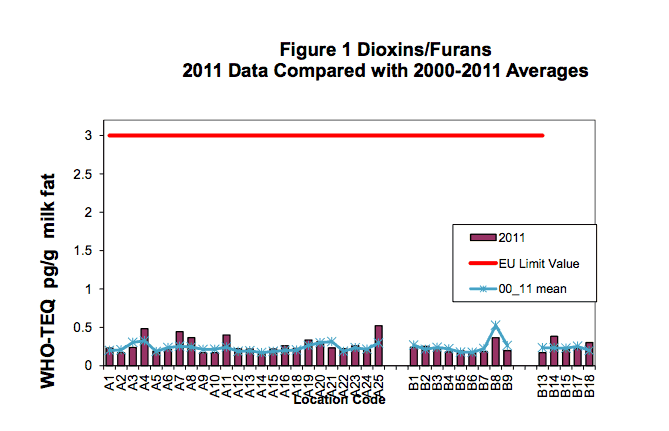
And in the case of Kerrygold butter in particular, we have the advantage of pretty good information about the level of dioxins occurring in milk, thanks to annual reports from the Irish Environmental Protection Agency which detail just this issue. And I’m no expert, but it appears that contaminants of Irish milk are very low.
Dioxin in Irish Milk

This chart shows dioxin levels in Irish cow’s milk compared with the EU limit value (the red line at the top of the chart). According to the report, Ireland compares favorably with other European countries, and the report says that exposure of Ireland’s citizens to dioxins is low.

From this I tentatively conclue that dairy products which are made with Irish cow’s milk, including Kerrygold butter, are probably very low risk from a bioaccumulative toxicity perspective. This, it would seem, is the best of both worlds: low toxin levels in the butterfat and the superior micro nutrient profile of grass fed dairy .

People eating a lot of grass fed butter (I’m looking at you, Mark’s Daily Apple guy) would probably be wise to investigate any known dioxin or other long-term contaminent issues in the area where the cows from which their butter is made graze in order to reduce their own bioaccumulation buildup.

What’s the takeaway from all this? Probably that you should consider moderating your consumption of dairy, particularly delicious high-fat, lovely, tasty dairy like cheese and butter. Sorry, that wasn’t the answer I was hoping for either. In fact, if I had known what I would find when I started this research I would have chosen to remain happily in ignorance, assuming I could eat grass fed butter and organic cheese with impunity.

But I am convinced that the superior flavor and low likelihood of contaminents make the relatively minor price increase between organic and Kerrygold butter worth it for my family. So it looks like I’ll be going grass fed from now.

What is your relationship with butter? Do you buy fancy grass-fed or organic butters?

Comments

  1. Laurel says:

    We get raw milk, raw butter and raw cheese locally and it’s all grass-fed. The only off-farm inputs are from organic sources. I trust my farmers completely because I know they are purists. If they feed it to their kids you know it’s good.

    • Christine says:

      People keep saying “what about grass fed organic butter?”. This is what I thought, and I found some here in California. Local grass fed organic butter. However, I am starting to realize that they have been spraying with chemtrails over our area. Since we are all supposed to pretend that this is not happening, surely the contaminated grass is still considered organic legally.

  2. Bella says:

    Erica,
    I know you said you didn’t want to hear it, but I would heartily recommend looking into locally sourced options. At my most recent residence, we had a local dairy that was small in scale and working towards their organic certification. Plus they delivered in nice little reusable glass bottles. And it tasted WAY better. And I know there is a certain amount of ‘oh I’m buying the best so it must taste better’ but this stuff really did taste better. So your article has given me the kick in the pants that I needed to find a new local, organic, grass fed (well see what we can come up with) source of milk and dairy. Because despite the very convincing argument to do so, I couldn’t personally bear to have my butter shipped from ireland.

  3. mothership says:

    Local is good & nice & PC & all….BUT I think the point Erica is trying to make is- dioxins are MOST readily available to the cow/goat/etc through grass NOT grain…. and unless you KNOW FOR SURE your local happy cows are not grazing on dioxin infested grass (which a CO certificate does not necessarily test for) you might be safer going with PROVEN low dioxin grass fed (the Irish stuff)…
    OR…. better yet…help a mother out &…be part of the SOLUTION-
    find out how to get your local dairies tested and THEN spread the word!!!!
    & speaking of helping a mother out…what’s next?
    For the legions of new mothers raised throughout their youth on fast/junk food
    will “studies show” it’s safer for them NOT to breastfeed…
    UGGGH! the can of worms opened here…
    if only we could go back to butter fed ignorant bliss!

    • Bella says:

      I guess my biggest issue with the recommendation, which I think adds an interesting philosophical debate is that the overall environmental cost of shipping butter from Ireland to Washington (or anywhere in the US) causes excess dioxin/toxin load ‘somewhere’. Is it okay for a dollar more to insure that my family gets dioxin free butter while at the same time encouraging more waste and toxins in the environment to others? How much of your food dollars are allocated to a vote of ‘people doing the right things’ versus ‘saving my family from the bad stuff’ versus just plain feeding a family a healthy diet. As a parent I agree that all are noble pursuits, that benefit my children in different ways and each person will draw the line somewhere.
      Now that I know this particularly interesting bit of research (thank you Erica), what do I chose to do with it – do I lower the consumption of butter in my household, switch to imported butter, start making my own from the raw dairy down the street, buy goats?

  4. Amy says:

    Huh. I wonder what the likelihood is of a certain field being contaminated is – is the stuff universal, or only in specific locations. Or, how one goes about testing for it. Can you get it in a regular soil test, do you think? Adding it to the list of things I need to check up on.

  5. Sarah says:

    You don’t have to give up cheese! Costco sells large bricks of Kerrygold Dubliner cheese from Ireland and it is delicious. :)

  6. Jaimee says:

    Thanks for the post Erica! We were just introduced to KerryGold butter only to discover we cannot get it locally for a reasonable price at all. If only Trader Joe’s would come to Champaign-Urbana… Anyway, we had previously been using Kirkland organic butter from Costco and were blown away by the difference ourselves. Now we are getting Rumiano grass fed butter through a food co-op and you’ve got me wondering what the dioxin profile looks like for the region where it comes from! Off to research…

    mothership: I also wanted to recommend a book called Having Faith: An Ecologist’s Journey to Motherhood by Sandra Steingraber. It was an engaging read, which talked in great depth about the toxins in breastmilk and her own conclusions about its safety. I read it years ago, but I recall her mentioning that we literally pour our toxins into our first breastfed child such that subsequent children receive much, much lower levels. At any rate, very disturbing, but if I remember correctly she concluded the pros outweighed the cons on breastfeeding.

    • Cindy says:

      Jaimee, I would love to know what you find out about the dioxin profile on the brand Rumiano… I buy their cheese (so far I haven’t found their butter locally). Thanks much!

    • smith says:

      Ya, but what kind of toxins are in baby formula? It’s typically made from cow milk from non organic cows fed gmo grain while living in their own feces. The alternative to dairy formula is made from hormone disrupting gmo soy. And that’s not including all the other synthetic ingredients added . I personally think breastmilk is always the better choice , barring medica ti on use by the mother , of course

  7. We are a certified organic farm in Canada. We have been certified since 1993, and we have strict rules as to how much room animals have, how much time spent outside and access to grass/ fields etc. It’s NOT just the feed that is at issue, (although it must be certified organic also) but the total life and care of the animal and what it comes into contact with -air, water, housing, feed , environment, prohibition of pharmiceuticals…and care. Just to be clear.

  8. Erica says:

    The problem with assessing bioaccumulative toxin levels is that pockets of high-pollutant areas will exist, but these will not necessarily be clearly identified or known, because testing for this stuff is rather expensive and tricky. In general, combustion from industrial practices (medical waste incinerators, wood pulp processors, etc.) is a huge contributor for dioxin soil contamination. The toxin rises as particulate and then falls out and settles onto the soil. Water is contaminated too, by direct discharge of industrial waste products into waterways. The currents can then carry the toxic load for some ways. So it’s a tricky thing to figure out exactly what locations have a higher toxin load than others, and in almost all cases, a farmer grazing his cows on contaminated soil would have no way of knowing. For those of us in Western Washington, the very close proximity of traditionally industrial zones, for everything from paper mills to treated telephone poles, with traditional farm land area, is….well, not encouraging.

  9. Rachel Hoff says:

    My hesitation with organic is that animals are not to be treated with medication (except for homeopathic, herbal, or other alternative methods) if they are to stay certified (it’s a humane treatment issue to me). So a sick animal can still be included in the producing herd. Smaller certified organic farmers would most likely just sell the animal off (generally for meat and at a loss), but with today’s factory farmed organic, less attention is paid to the individual animal which could mean an animal with mastitis is putting milk into the system (somatic cell counts of organic are the same as conventional). The bonus, however, is that new certification requirements make pasture a requirement for all ruminants (cows, sheep, goats). Hay does not count. Here’s some more info on the organic certification of livestock: http://www.mosesorganic.org/attachments/productioninfo/fstransdairy.html

    I wouldn’t buy grassfed products if the animals were raised in an industrial or urban area, but if they are out on a rural ranch where dioxin contaminated land is less of an issue (dioxins are most present where burning of waste, especially plastics, has occurred or crops have been sprayed with pesticides), I wouldn’t worry too much. Chicken eggs from backyard poultry are a bigger concern. More good info: http://www.ehib.org/papers/Dioxin.pdf

    • Rachel Hoff says:

      I should probably note that I do have dairy goats in an urban area, but we bring most of their feed in. They get very very little pasture from our property and being the picky bitches they are, they won’t eat anything under withers height.

    • thixotropic says:

      They can and do treat a sick animal with the necessary medication — they’d have to, or it could make other animals ill, in addition to also making the animal suffer! They just don’t use the milk from her till she’s done with the treatment. And for any antibiotics and other medications there are guidelines for how long it takes for that medication to be cleared from the animal’s system.

  10. Kat says:

    For those looking to understand the dioxin problem from a scintific standpoint, please read this 2010 study from the Washington State Department of Ecology.
    For those interested in just the results in plain English, read page 49, bottom half of page.
    https://fortress.wa.gov/ecy/publications/publications/1003007.pdf
    Essentially, even background levels of Dioxins in Washington State (think Cascade Wilderness) exceed human health limits. I’d guess that any grass-fed livestock in Washington (eastern or western) will display increased levels of bio-accumulated toxins, just as the fish in this study did.
    That said, I have my own dairy goats and dual-purpose cows on my two acres. I also fish in the local streams and lakes….

  11. Be afraid, be very afraid! We have not even started to worry about the radioactive fallout from Fukushima. At some point we have to acknowledge that we live on an increasingly toxic planet, do the best we can, support our organs of elimination, and let it go at that. STRESS is not good either and we can drive ourselves stark raving bonkers worrying about every bite. I have no access to Costco but am drooling at those prices. My delicious Dairyland European-style cultured butter is almost $6 per pound now. Neither grass-fed nor organic, alas. The organic stuff is twice that price. I draw the line somewhere.

    • Erica says:

      “STRESS is not good either and we can drive ourselves stark raving bonkers worrying about every bite.” So true. I’ll freely admit I went down the rabbit hole with this post – it was supposed to be a simple taste test and then…well, my research geek came out. ;)

    • Please, do not spread FUD about radiation from Fukushima. You are at literally ZERO risk of any negative health effects from the events there, as are the overwhelming majority of Japanese people.

      Similarly, while it’s true that dioxins and related compounds are quite nasty at certain levels, they tend not to be all that bio-available in terrestrial ecosystems, as they bind fairly tightly to soil particles aren’t soluble in water, and are only taken up in very small amounts by plants.

      I don’t know that I would be terribly concerned about this issue, unless I knew that the farm I was buying my butter from was downwind from an operating municipal waste incinerator or other site that was likely to be producing a lot of airborne contaminants.

    • thixotropic says:

      Thank you — I was just thinking this myself, reading these comments. Do the best you can and don’t overthink it too much. The effort you do make, makes a difference, and that’s where you’re helping to be a part of the solution and helping your family too. Driving yourself nuts over it is terribly stressful, and you won’t enjoy your food as much either.

  12. Karen says:

    Having just attended a fantastic presentation on climate change by local weather guru Dr. Cliff Mass, I have to say that while focusing on potential dioxin contamination is interesting, we’re missing the forest for the trees. In his presentation, he outlined what our increased use of fossil fuels is doing to the climate of this planet. If our global fossil fuel use isn’t checked, then by his models in 2090, the Pacific Northwest will experience 180 days over 90 degrees. (I kept staring at that graphic thinking I must have seen it wrong, but it was there in black and white.) Our children may be alive to experience that, and our grandchildren certainly will. If I have to be exposed to a little more dioxin (which I’m already plenty exposed to anyway) by buying local in order to save my kids from that? That’s a no-brainer. Sorry Kerrygold. Your butter may be good, but it’s not that good.

  13. Kay says:

    How timely! My health care provider recently told me that part of my high cholesterol problem might be due to the fact that I am consuming too LITTLE dietary fat. She of course recommended olive oil which is already my staple, but also suggested that since I don’t eat red meat, that I at least consume more dairy fat (Happy me!) but with the caveat that it needs to be from grass-fed cows to avoid the gluten/carb transference which she says is the real culprit in hypolipidemia. So I have been reading and researching and becoming more confused. I thank you so much for all your research and your balanced presentation. You have helped decide to stick with organic until I find butter and cheese that are both grass-fed AND organic. PS: Many (almost 20?) years ago, the owner of my neighborhood health food store said to me, “If you can only afford to buy one thing that is organic, make it butter.”

    • Lady banksia says:

      Kay – I’m curious now – ‘gluten/carb transference’? Please elaborate in layman’s terms, as I did a “G” search for it and only this reference came up.

      Thanks…

      • Kay says:

        Lady Banksia, Sorry to say that I don’t really understand it either. She just said that carbs were more to blame for my hypolipidemia (high cholesterol) than dietary fat is. She said to cut out pastas, breads, etc and include more animal fat. Since I don’t eat much meat (no read meat), she said I should get my animal fat from dairy products from grass-fed cows. The theory being, I guess, that if the cows have been grain fed, then I am not avoiding the carbs. Michael Pollan talks about this very thing in his book, “In Defense of Food.” I wish I could be of more help, but I’m still in the process of understanding it myself. (After reading Erica’s article, though, I’m sticking with organic.)

        • Mati says:

          Just to clarify, hypERlipidemia is high cholesterol. Hypo is low.

          • Kay says:

            Thanks, Mati, someone pointed this out to me earlier and, I’m embarrassed to say that I actually knew it, too, but must have had a senior moment when I was trying to explain my situation. *red face*

    • thixotropic says:

      Carbs (especially simpler carbs like bread and pasta) cause hyperlipidemia (hypo = low) by jacking your insulin levels up, causing you to store more of their energy as fat, and also raising your triglycerides. Those are much more problematic than cholesterol, which we need, esp. as we age and our liver makes less of it.

      I had an LDL of over 200 and climbing — stopped nearly all of the simple carbs, eat only the least processed carbs (like rolled grains in hot cereal with lots of cinnamon for its insulin benefits and yumminess). I also increased my eggs, meat and dairy. Now my LDL is 70. (I also use a lot of olive oil; coconut oil for cooking, though.)

      Saturated fat/cholesterol make up ~25% of your brain tissue, iirc. Egg yolks, it turns out, help regulate your total cholesterol, in addition to being an excellent source of choline (also key for heart health) and lutein.

      • Kay says:

        Thanks to thixotropic for this helpful information. My insurance will no longer pay for my cholesterol meds ($400 per mo.) and there is no generic , so I’m going cold turkey in an effort to take care of it myself with diet and exercise. I love the idea of allowing myself more good fats and, so far, am not really missing the pasta, etc. Thanks again for for your encouraging story.

  14. Barry says:

    Erica, I’m guessing one of your taste-testers has a saltier language than the other [see 1st rater comment], but I like your conclusions. The chefwife here is fiercely partial to Plugra (unsalted, of course), but this souschef will grab salted butter if left unsupervised in the store. Kerrygold is flat out a bargain, and often it just tumbles off the shelf as I’m pushing the cart by the dairy section at Fred’s. I can see a sequel to this post being about lard and coconut oil, surprises a-mundo when compared to oleomargarine .

  15. dixiebelle says:

    Ha! I buy salted butter that is made from milk from cows who eat organic grass, it is made in Australia, tastes fantastic and gives me that all important butter-snobbery feeling too.

    Any interested Aussies: http://www.180acres.com.au/our-products.aspx

    • dixiebelle says:

      Oh, and we just signed up for a local Herdshare, so we now own a share of an ethically raised, grass fed, chemical free cow, and therefore own part of it’s (unprocessed) milk, which we will be getting delivered twice a week. Maybe I can be making my own butter, and have even more reason to gloat!

  16. Joycelyn says:

    [comment redacted by admin to prevent copyright infringement]

    “If you believe that it is wrong to harm and kill animals for pleasure, then you should not consume milk or dairy products. Please visit our Milk Myths page to learn more about the humane and health myths of dairy, and visit our Vegan Food and Nutrition page for tips and links to delicious dairy alternatives.”

    See full article at http://current.com/1b3n8kc

  17. Teresa says:

    I think my takeaway here is to use more olive oil where the flavor of butter isn’t utterly critical.
    Of course, olive oil is all shipped from somewhere far away from New England, so that solution has its own drawbacks.
    And olive oil would be odd in chocolate chip cookies.

    • thixotropic says:

      Some of the world’s best olive oil is grown and pressed in California, and your chances of unadulterated product are much better if it’s from here rather than imported — and it doubtless goes mostly by train, which is by far the most fuel-efficient method of transport.

    • Jen says:

      “…olive oil would be odd in chocolate chip cookies.”

      I use macadamia nut oil for my chocolate chip cookies. It has more monounsaturated fat than olive oil, and I think its flavor goes well with cookie ingredients like brown sugar.

  18. Teresa says:

    And as someone who’s always lived in dairy country in the northeastern US, I don’t think I could bring myself to buy butter from Ireland. Just. Not. Right.

  19. I sincerely appreciate the geeky research. AND….after all this angst……let’s all take a few deep breaths and re-read Erica’s hilarious post about the tragedy of the healthy eater, or whatever it was called. One of my favourite pieces. There. I took the time to look it up for you. http://www.nwedible.com/?s=tragedy+of+the+healthy+eater

  20. Maynard Keller says:

    I would’ve like to have seen “hi-tech” full butter alternatives included here (because they’re what I use these days. E.g., Butters mixed with olive oil and/or canola (full calorie and “light”), and products like Smart Balance made of various blends of vegetable oils (soy, palm fruit, olive, canola and flaxseed).

    Asking as I do find their taste quite acceptable and do sautee and fry eggs with Smart Balance.

    • thixotropic says:

      Canola oil is nasty stuff. It’s GMO, has two different native toxins, and is not a healthy form of fat. (Soy is also GMO and not healthy either.)
      Both are GMO to enable them to be sprayed heavily with Round-Up, which is an herbicide with some seriously nasty health effects, and which also kills bees.

      “Hi tech” is not a good thing when it comes to food. The processing usually involves heat at a minimum, and that is *very* bad for oils — it makes them bad for you even if they were good to start with. You want the lowest-tech, least-processed food. Always.

  21. Amy says:

    Thank you for your geeky research! I have found myself several times in the aisle at Whole Paycheck, picking up the Kerrygold, then the organic, then the Kerrygold. I always settle on the Kerrygold because of the grass-fed caveat. I do also try to avoid the gluten transference from the grain-fed cows. As a vegan-turned-paleo (!) eater, any dairy is a treat, rather than a staple, and certainly not a necessity, so we’re not eating it very often. This post was really helpful, though, because I was considering the herdshare options in my community for raw milk products, but now think I won’t. We’re in the Midwest, and our city is surrounded by coal-fired power plants just raining that toxic soot on our soils. Hello mercury!

  22. Sue says:

    It’s always so hard to balance all these factors. I’ve decided that for many things if I can’t get organic I prefer European products as they are much more restrictive as far as GMO’s and rBST/rGBH–and, oh, the flavor!! I’ll pick conventional Euro cheese over conventional US cheese 8 days a week. That said, I try as hard as I can to buy as much Organic as possible. I cook with grapeseed oil, rice bran oil or olive and I’m just starting to experiment with coconut oil. Still, you can’t beat really good quality butter for the flavor… oh, the dilemmas… I guess I’ll just have to keep trying to do the best I can to balance all of the issues. Sometimes one factor wins out, sometimes another one does. In any case, trying is always better than not trying.

  23. susan says:

    If I spent all my time worrying as such I would eat nothing. Organic or not. Grassfed or not. My response is merely what are you doing to keep your body healthy so it can detoxify itself? While, yes, organic butter is not perfect it is still better than conventional. All food has an environmental impact same as health impact. Whether it is helpful or detrimental generally doesn’t present itself immediately. It took me three years to get myself turned around from a decent into lupus. It took more than a change in diet. While I can lightly pepper my diet with conventional foods ii can feel the difference. It takes more to feel full thus a heavier toxin load. A high fat diet has been important for me to feel satisfied and lose weight. Butter and lard are awesome vegetable fats don’t make the cut. Anyway, I’ve had 7 years to relax and quit feeling overwhelmed. It makes a big difference if you don’t stress. Btw stressing causes your body to hold toxins as well. Just figure out how to keep yourself detoxed and work to reduce the level of toxins you eat. You’ll do fine and be fine. Oh and not all local producers are created equal. Many settle for using conventional grains because it’s too hard to get organic. Some feed them in a feedlot situation all year. It’s all variable. Frankly it’s hard to take a farmers word for it sometimes. You have to see what they do and sample their products and compare it to others. Just because it tastes a little better than the store means nothing.

  24. Tyne Rochette says:

    I am voting for organic grassfed butter, as I suspect this limits the bioaccumulation problem and adds all sorts of other health benefits.

    We eat a combination of healthy fats though, as some of us can’t have dairy. We eat pastured pork lard and coconut oil, mostly. Butter is really only something that is spread on the toast of those who can eat it, so we buy grassfed organic butter or make our own from our dairy share.

  25. Kirsten says:

    Mmm, butter.

    We are looking into getting a share in a local dairy cow soon, which will give us 8-10 litres/week of organic-conversation, mainly grass fed dairy milk (should be certified organic in a year or so). That won’t actually meet all my family’s needs, but we can’t afford two shares at the moment (even two shares might not if we were to start making our own cheese, which seems to use a LOT of milk. But I’ve only made ricotta so far, so what do I know?), so it will have to do as a start.

    Is there no grass fed organic butter available to you?

  26. Kirsten says:

    PS Thanks for the research. It did give me the kick up the butt to email our local dairy farmer about going to visit her farm next week so we can get on with it.

  27. Kara Cozier says:

    Great article! Would it be ok to guest post it on my blog? My readers would love this one!

  28. joe says:

    Try Organic Valley Pasture butter. It’s pretty expensive and not quite as falvorful as Kerrygold but its grassfed and organic. Still going to kill you.

    • LIFE kills, sooner or later. The trick is to enjoy the interval. Which means eat butter.

    • Dana says:

      You’ll die faster not eating the butter. I honestly believe her butter consumption was the reason Paula Deen was diagnosed with type 2 diabetes in her sixties rather than her forties despite all the sugar she also ate.

      Seriously, the stuff is protective. So are all the other animal foods, including the organs (including–gasp!–liver).

  29. Dana says:

    I care more about the nutrition I am getting from my food than I do about traces of toxins that might be in it. If you are not getting nutrition from your food then you are wasting your body’s resources on something from which you get very little return. And you definitely won’t be equipped to deal with the toxins YOU WILL STILL ENCOUNTER even if every single food in your diet were produced organically.

    You can’t get away from it and I think the main reason that’s true is we focus more on risk avoidance than we focus on risk elimination. If everyone who dissed grass-fed would spend that time fighting the chemical companies instead, we might get somewhere.

    Also think about all the products you buy that are producing these toxins. If you refuse grass-fed and eat organic-but-not-grass-fed but you’re still buying plastics and petroleum-based household cleaners and every new electronic gadget that comes out (guess what: toxins were used to make them) then you’re not really helping anything.

Trackbacks

  1. [...] Kerrygold Butter (this is a really good butter as it is from grassfed cows, grassfed/pastured cows milk is always healthier and less inflammatory than grain fed cows milk)/half pound: $2.33 Costco (this was bought in bulk with two other half pound sticks of butter: total cost for 3 is $6.99) We will only be eating 1/2 pound of butter this week. [...]

Your participation makes this whole thing work, so join in! Comment policy: Wheaton's Law enforced here.

*